 LibreChatMessaging without internet
A messenger where the phones are the network
How LibreChat floods messages across a Bluetooth mesh, holds them for a day when there's no path yet, and starts Signal-style encrypted chats with no server to hand out keys.
LibreChat is a messenger that works with no internet, no mobile signal and no server. The phones around you become the network: a message for someone out of range is carried by the phones in between.
What it solves
At a festival, on a trek, in a building with no signal or during a power cut, the network goes first. Everyone still has a phone in their pocket, and those phones can still reach each other over Bluetooth. They just have nothing to send through.
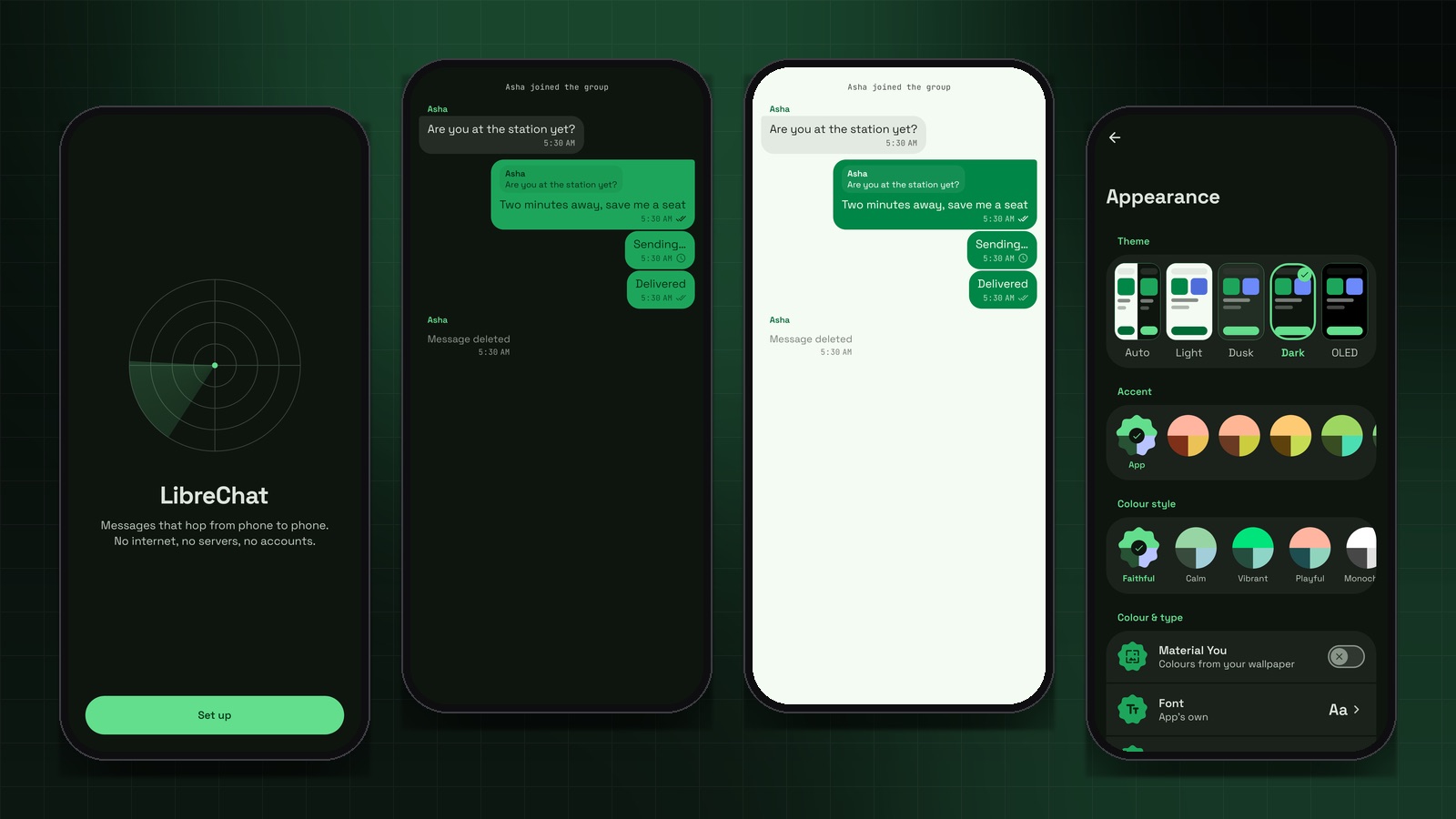
LibreChat gives them that. There’s a public chat for everyone in range, signed so nobody can post as you. Direct messages and groups are end to end encrypted. Photos and voice notes, receipts, replies, reactions, disappearing messages, QR code verification and a radar of who’s nearby all work without a single server.
Built with
- Kotlin and Jetpack Compose with Material 3, on Android 10 and up.
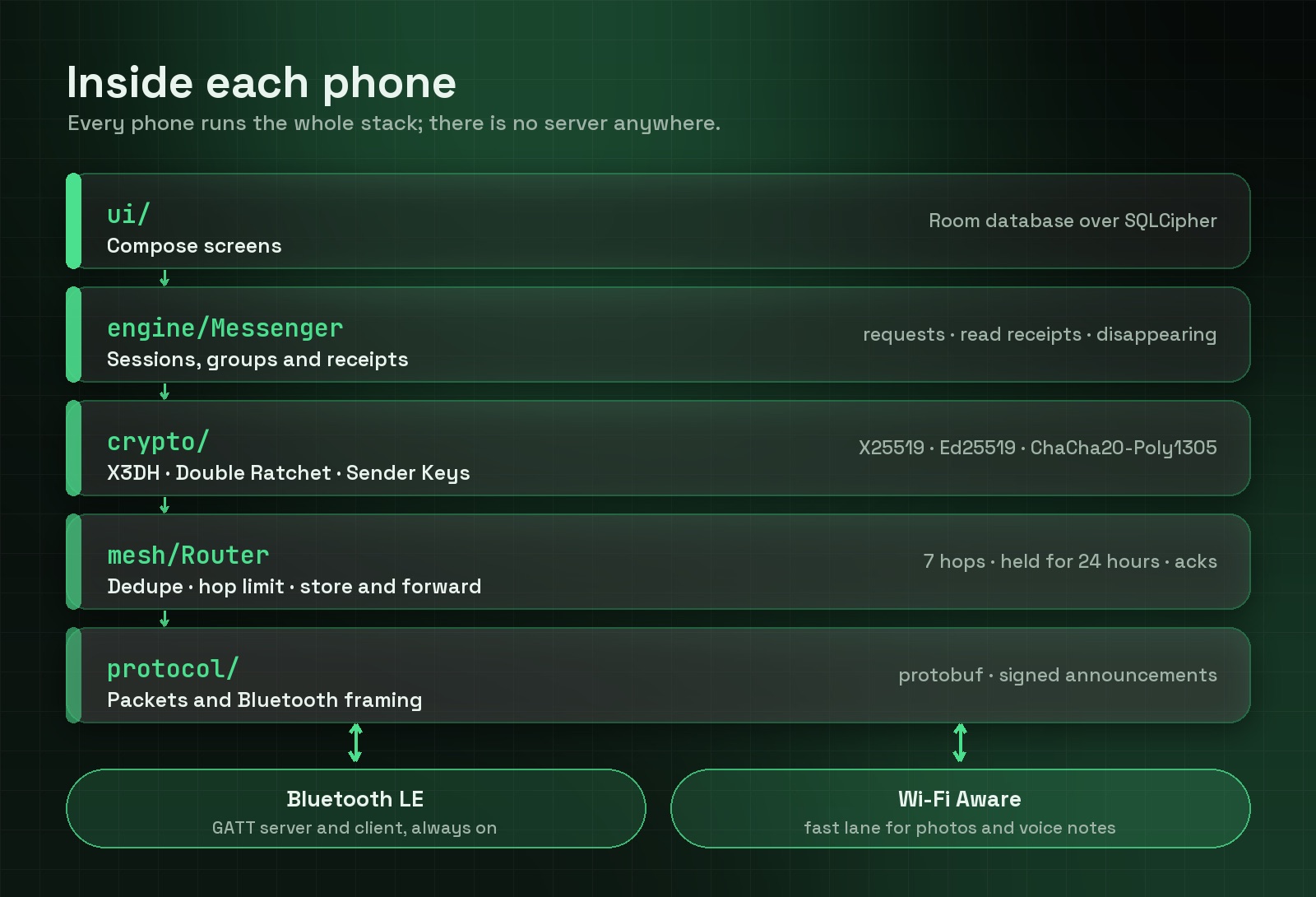
- Bluetooth Low Energy GATT for the mesh, and Wi-Fi Aware for fast links when both phones support it.
- BouncyCastle for the primitives: X25519, Ed25519, ChaCha20-Poly1305 and HKDF-SHA256.
- SQLCipher for the message database, encrypted media files, and keys guarded by the Android Keystore.
- Protocol Buffers for packets and sessions on the wire and on disk.
Flooding, carefully
Every phone is a Bluetooth server and a client at the same time: it advertises the LibreChat service and scans for it. Every 15 seconds it announces itself with its name and public keys, signed.
The simplest routing that works on a network nobody planned is flooding: send every packet to every neighbour. It needs two guards to stop it from melting the network. Each phone remembers the last 5,000 packets it has seen and ignores repeats, and every packet carries a hop limit that starts at 7 and drops by one at each phone.
Here’s the heart of the router. All of it is plain logic with no Bluetooth in sight, which is what made it testable:
val seenAt = seen[packet.key]
if (seenAt != null) {
    // The sender is retrying because our acknowledgement got lost.
    val again = packet.type == PacketType.DIRECT && packet.recipient == me
    // A retry of someone else's direct message: pass it on again,
    // but rarely enough that copies circling the mesh die out.
    val now = clock()
    if (packet.type == PacketType.DIRECT && !again && packet.ttl > 1 && now - seenAt > REFORWARD_MS) {
        seen[packet.key] = now
        val next = packet.copy(ttl = packet.ttl - 1)
        sends += targets(next, from = link).map { Send(it, next) }
    }
    return Routed(if (again) packet else null, sends, duplicate = again)
}
seen[packet.key] = clock()
if (packet.sender == me) return Routed(null, sends)

val forMe = packet.recipient == me
val deliver = if (packet.isBroadcast || forMe) packet else null
if (!forMe && packet.ttl > 1) {
    val next = packet.copy(ttl = packet.ttl - 1)
    val out = targets(next, from = link).map { Send(it, next) }
    sends += out
    remember(next, out, fromPeer = linkPeer[link])
}
Two details in there are easy to get wrong. A duplicate addressed to me still gets delivered again, because it means the sender never got my acknowledgement and is retrying. And a duplicate addressed to someone else is passed on again, but only if 20 seconds have passed, which lets retries cross the mesh without copies circling forever.
The seen set itself is a LinkedHashMap that drops its oldest entry past 5,000, which is the cheapest bounded memory I know of in Kotlin:
private val seen = object : LinkedHashMap<String, Long>(4096, 0.75f, false) {
    override fun removeEldestEntry(eldest: MutableMap.MutableEntry<String, Long>?) = size > SEEN_MAX
}
When there’s no path yet
Flooding only helps if a path exists right now. At a festival, people walk in and out of range all the time. The friend you’re messaging might not be reachable for an hour.
So every phone keeps a copy of what it relays, for up to 24 hours, within limits of 600 packets and 4 MB. When a new neighbour announces itself, it gets every stored packet it hasn’t been given before:
private fun replayTo(link: String, peer: String): List<Send> {
    val now = clock()
    return store.values.filter { it.until >= now && peer !in it.sentToPeers && it.packet.sender != peer }
        .map { s ->
            s.sentToPeers += peer
            Send(link, s.packet)
        }
}
That’s store and forward: a message can cross the mesh even when the path only ever exists in pieces, at different times. When the recipient finally gets it, their signed acknowledgement travels back and relays drop their copies.
Encryption with nobody in the middle
Signal-style encryption normally relies on a server. Before your first message, you fetch the other person’s prekeys from it. With no server, there’s nowhere to fetch from.
The fix is to carry the server’s job in the announcement. Each phone includes its signed prekey in the announcement it already broadcasts every 15 seconds, so anyone who can hear it has what they need to start a chat. LibreChat runs X3DH without one-time prekeys: three Diffie-Hellman agreements, mixed into one shared secret:
fun initiate(me: Identity, them: PublicIdentity, prekey: PublicPrekey): Started {
    if (!them.isValid()) throw CryptoException("their identity key is not signed correctly")
    if (!prekey.verify(them)) throw CryptoException("their prekey is not signed by them")
    val ek = X25519KeyPair.generate()
    val dh1 = X25519.agree(me.dh.private, prekey.key)
    val dh2 = X25519.agree(ek.private, them.dhKey)
    val dh3 = X25519.agree(ek.private, prekey.key)
    return Started(kdf(dh1, dh2, dh3), ek.public, ad(me.signing.public, them.signingKey))
}
After that, every message goes through the Double Ratchet, which handles messages arriving out of order and keeps keys for skipped ones. A mesh makes some things more likely than they’d be on a server, and the code has to expect them:
- Both sides start at once. Two people message each other before either has heard back, and now there are two sessions. LibreChat keeps up to three sessions per person, tries each one when decrypting, and sends with whichever last worked.
- The first message gets lost. The prekey header rides along on every message until the other side replies, so any of them can start the session.
- An old first message is replayed. Each session remembers the ephemeral key that started it, and a first message with the same key is refused.
Groups use Sender Keys: each member encrypts once for the whole group, the keys are shared over the one-to-one sessions, and they’re replaced whenever someone leaves. Public chat is signed, not encrypted. Relays can see the sender and recipient ids, sizes and timing, but not contents.
Testing it
This is where most of the time went. Every primitive is checked against its RFC test vectors (7748, 8032, 5869, 4231 and 8439). The ratchet is tested for out of order delivery, skipped messages, replays, tampering and serialisation. Sender Keys are tested for forgery, replay and late joiners.
Then whole flows run over an in-memory mesh of three phones, where A can only reach C through B: delivery ticks, waiting for an unknown recipient, store and forward, lost acknowledgements, groups and admin hand-over, photos and re-requesting lost pieces, disappearing messages, blocking and forged announcements. Because the router and the engine never touch Bluetooth directly, all of that runs on a laptop in seconds.
Bluetooth itself still needs real hardware, so the last test is always the same: install it on three phones and walk apart.
Where it stops
LibreChat is open source and has had outside contributors. It hasn’t had an independent security audit, and the README says so plainly in the encryption section. If you need audited encryption, use something that’s been audited. Bluetooth is also slow, so photos over a long chain of phones take minutes unless Wi-Fi Aware can step in.
The source is on GitHub under Apache 2.0.